
Corrections and Context, With Receipts
Claim: $240 Million in Tax Discounts
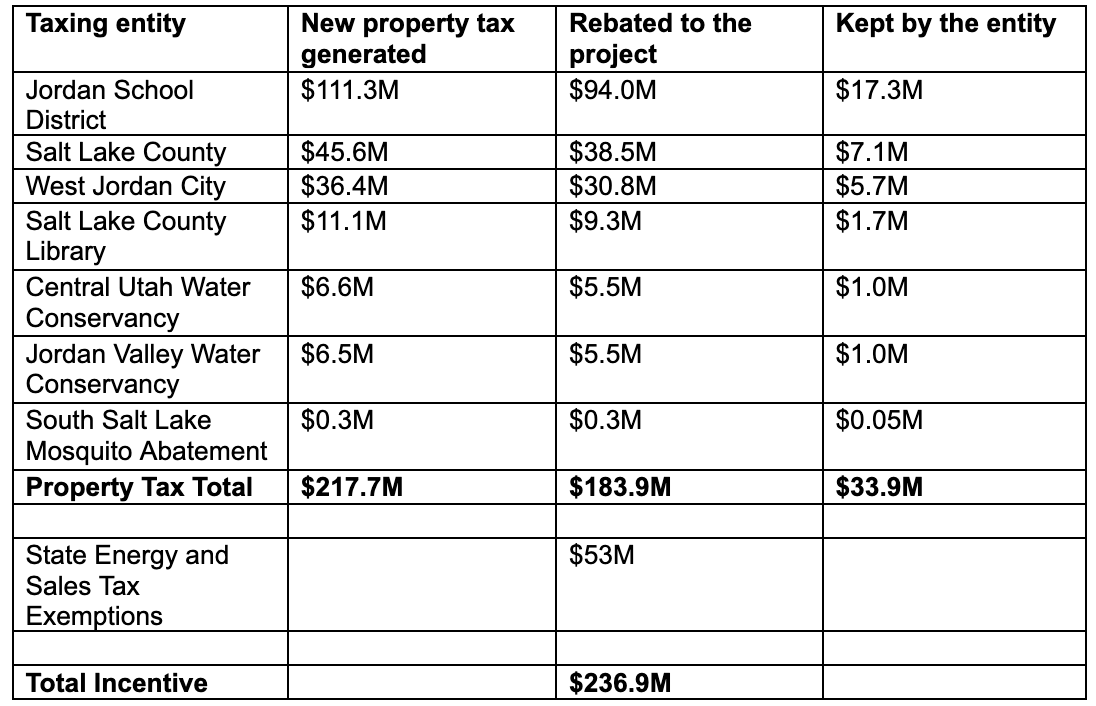
Additional Insights: The $240 million total amount is pretty close to what was discussed, spread over 20 years. For the West Jordan part we would have collected about $36.4M in new property tax over 20 years, rebating up to $30.8M if all conditions were met, leaving the City $5.7M in new tax revenue that didn’t have to come from residents. This was for land that was contributing about $26 per year to the city (not a typo, just twenty-six dollars).
The mailer could be read to imply that West Jordan was offering $240 million, when this is really across multiple agencies, each with their own amount. West Jordan was considering an average incentive of about $1.54 million per year only after they paid their taxes first and met other conditions.
Sources:
https://archive.sltrib.com/article.php?id=4208725&itype=CMSID&fullpage=1
Project Budget – Appendix C of the RDA Packet for August 24, 2016 (starts Page 40)
https://lfforms.westjordan.utah.gov/WebLink/DocView.aspx?id=148717&dbid=0&repo=City-of-West-Jordan
Claim: 5.3 Million Gallons of Water Per Day
Additional Insights: The facility would require water capacity of 5.3 million gallons per day, but was not expected to use that much. The full citation of the article they cited reads “West Jordan City Manager Mark Palesh said reports that the data center would use 5.3 million gallons of water per day were based on the company's worst-case scenario — that it had built all six phases, was operating at full capacity on the hottest day of the year and needed to fight a fire.” Utah requires water systems to be sized to handle both that peak day demand as well as firefighting during an emergency.
Actual expected usage was a point of frustration. The company said it would be less than 1 million gallons per day but never published a specific number. Since this discussion happened a decade ago we have the benefit of hindsight and can look at the data center they actually built in Los Lunas which averaged 101,300 gallons per day in 2020 and after expansion their 2024 usage averaged 182,400 gallons per day. That works out to less than 4% of that cited 5.3 million gallons per day number, but yes, that’s still a lot of water, about what 280 West Jordan homes use in a day.
Sources:
Article Citation: https://archive.sltrib.com/article.php?id=4208725&itype=CMSID&fullpage=1
Water Requirements: https://adminrules.utah.gov/Rule/683/51/680/R309-510 (See R309-510-9)
Water Withdrawal: https://sustainability.atmeta.com/wp-content/uploads/2025/10/Meta_2025-Environmental-Data-Index.pdf See Page I under “Los Lunas (NM)”, and as a tangent you can also see Eagle Mountain (UT) as well. Also note the measurement is “megaliter” which is 264,172 gallons, so you need to multiply by 264,172 then divide by 365 to get daily gallons.
Average home use: West Jordan City Council minutes, March 23, 2022 (water master plan, about 650 gallons per residence per day)
Claim: Fewer than 100 jobs
Additional Insights: Pretty accurate, although the range was 70 to 130 depending on which article you cite.
But we weren’t looking at it as if the benefit was job creation. We were considering the property tax revenue that would help fund services without having to draw from residential property taxes. Our perspective was this would bring the school district about $17 million over 20 years (per the table above) but with only about 100 jobs we’re not going to see a big impact on streets, additional students, or additional draws on the system. This was really the driving thought behind our willingness to consider any tax incentive. The money being paid in was far more than would be used, and even with incentives would pay beyond their impact.
Sources:
70 - 100 jobs: https://www.ksl.com/article/40956221/largest-data-center-in-the-world-could-land-in-west-jordan
70 - 130 jobs: https://www.deseret.com/2016/8/24/20594737/west-jordan-revising-bid-for-facebook-data-center/
130 jobs: https://archive.sltrib.com/article.php?id=4208725&itype=CMSID&fullpage=1
Claims: “As a council member, Chris McConnehey voted YES to the proposed data center” and “Chris McConnehey made the motion to approve the project plan”
Additional Insights: This mixes up two very different things. The mailer describes a data center deal ($240 million in tax incentives, 5.3 million gallons of water a day, fewer than 100 jobs) and then says I voted “yes” to it. That didn’t happen. We never got far enough in discussions to vote on a final deal. The votes they cite laid groundwork for discussions, but don’t do anything close to what the mailer suggests. One authorized a study. The other created an economic development area. Neither vote authorized any tax incentive, approved any water usage, or secured any type of agreement with Facebook.
March 31, 2016: a study. Several companies had been asking about locating along U-111 in the southwest part of the city. This vote authorized staff to prepare a plan and a cost-benefit analysis for a possible economic development area there. It approved no plan, no budget, no company and no incentive. I seconded it, and it passed unanimously.
July 27, 2016: the Project Area Plan. This created the Pioneer Technology District, about 1,700 acres meant for “a variety of businesses, including office, industrial, and warehousing.” Think of it as drawing a boundary on a map and saying, “this is where we’d like to recruit large employers.” It made the area eligible for incentives but didn’t approve any. Nothing in it committed the City to a company, a tax incentive, a water allocation or a number of jobs. An actual incentive would have needed a separate budget approved by the County, the school district and other taxing entities, plus a development agreement approved by the Council. I made this motion, and it passed unanimously.
Yes, Facebook was interested in the area, and the plan mentions it. But staff were clear that any agreement “would be provided to the City Council for approval,” and it never was.
To be complete: that same night in the Redevelopment Agency meeting I seconded a resolution approving the proposed budget for the district. State law requires that step before a budget goes to a public hearing and to the other taxing entities for their approval. They didn’t approve it, and it was never adopted.
Sources:
West Jordan RDA minutes, March 31, 2016 (Resolution 182), pp. 1 to 3
West Jordan City Council minutes, July 27, 2016 (Ordinance 16-33), pp. 10 to 12
Pioneer Technology District Project Area Plan, RDA packet, July 27, 2016
West Jordan RDA minutes, July 27, 2016 (Resolution 185), and August 24, 2016 (budget continued, never adopted)
West Jordan RDA budgets, FY2025 and FY2026 (Economic Development Area #5 listed as “not activated”)
Claim: “Chris McConnehey… voted for the rezone”
Additional Insights: Each line on this mailer is carefully worded to be technically true when read independently, but put together, they convey something that isn’t true. It says Facebook wanted a data center with big tax incentives (true). It says I voted for the rezone, which is also true. The disconnect is that this rezone did not approve the “massive data center – and $240 million in tax-payer incentives” that the mailer tries to connect to the rezone.
The rezone, requested by the property owner, changed the Jones family’s land from agricultural (A-20) to light manufacturing (M-1). That zoning could be used for a data center, yes, but also for manufacturing and assembly, warehousing and distribution, or similar light industrial businesses. A zoning change doesn’t approve anyone to build anything. It only sets what kind of development can be proposed. The rezone gave nothing to Facebook or anyone else.
Sources:
West Jordan City Council minutes, July 27, 2016, pp. 4 to 5 (consent item 5b, Ordinance 16-32)
West Jordan City Council minutes, May 25, 2016 (rezone hearing, postponed at the family’s request)
Salt Lake County Assessor parcel records, retrieved October 2026 (parcels 26-10-300-007, 26-10-326-013, 26-10-400-005)
Claim: “Chris McConnehey made the motion to approve the Pioneer Technology District project-area plan.”
Additional Insights: The Pioneer Technology District didn’t approve a deal for any company. It didn’t approve any tax incentive, any water use, any jobs commitment or any agreement. It created an economic development area with a goal, in the plan’s own words, “to bring employment and private investment to West Jordan.” Yes, I made that motion.
That’s why it’s misleading to wrap this vote in headlines like “THE DATA CENTER DEAL” and “Chris McConnehey didn’t just vote for the Facebook deal. HE PUSHED IT FORWARD.” The Facebook proposal and the Pioneer Technology District were two different things, and only one of them was adopted.
Source: West Jordan City Council minutes, July 27, 2016, pp. 10 to 12 (Ordinance 16-33)
Claim: “Facebook’s massive data center project needed someone to move it forward. Councilmember Chris McConnehey made that motion.”
Additional Insights: If you’re still reading, I applaud you. Not many folks dig this deep into the details. Have you considered running for office? Or serving on the Planning Commission or another City committee? Not joking at all. The City could really use people who take the time to get the full picture before making decisions.
Back to the claim that this pushed Facebook forward. Honestly, it’s getting a little tedious to keep saying “missing context” or “the motion they cite doesn’t come close to doing what they imply.” So let me try something different on this one and argue their side.
Did this motion help Facebook’s project move forward? Indirectly, at best. Creating the area gave the City tools to support new development, and Facebook was the first company interested. But it wasn’t tailor-made for Facebook. The site Facebook was looking at was about 230 acres. The Pioneer Technology District was about 1,700. Even if the deal had gone through, Facebook would have been a little under 15% of the whole picture.
We saw the west side as a much bigger opportunity. We’d talked about it in meeting after meeting: room for a mix of businesses that could support each other and grow together, with great views across the valley and the Oquirrhs behind them. That vision was the driver. A change in state law that year set the timing. It wasn’t a Facebook project we were pushing forward. It was a West Jordan project.
So it pushed Facebook forward in the same way it pushed forward any other company looking to build out there. And remember, Facebook went to New Mexico. If the goal was to push their project forward, I clearly failed.
Sources:
West Jordan City Council minutes, July 27, 2016, pp. 10 to 12 (Ordinance 16-33)
Pioneer Technology District Project Area Plan, RDA packet, July 27, 2016
Claim: “Residents learned the details only after the framework was in place.”
Additional Insights: The framework was discussed and debated publicly. For a time the company’s name was withheld from the public, and it was withheld from the City Council too (more on code names below).
Every piece of the framework went through open meetings with public comment or public hearings. The economic development area was studied in March, put out for public notice in June, and adopted in July. The rezone had its own public hearing in May. The proposed incentive budget, including the dollar amounts each entity would contribute, was published in a public notice in July, before Facebook’s name was ever reported. It then had a public hearing on August 10.
And it wasn’t just West Jordan working in the public view. The County Council, the State School Board, the school district and the committee of taxing entities all took up the proposal in public meetings over those months. The press covered every step, which is why the attack ads can cite so many news articles. The proposal didn’t get the approvals it needed from the County and the State School Board, so it died before it ever came back to West Jordan for a final vote.
That public process is a big part of why the deal didn’t go through. Everyone had the chance to see the framework and weigh in on it.
Sources:
West Jordan RDA minutes, March 31, June 22 and July 27, 2016; City Council minutes, May 25 and July 27, 2016
West Jordan RDA public notice of budget hearing, July 11, 2016 (in the RDA packet, July 27, 2016), listing “an estimated $134 million in property tax revenues” by entity
West Jordan RDA minutes, August 10, 2016 (budget public hearing)
Utah State Board of Education Discussion https://www.schools.utah.gov/board/_board_/_minutes_/2016/August%2023%20Full%20Board%20Meeting.pdf
State School Board delays vote, August 12, 2016: https://www.kuer.org/business-labor/2016-08-12/state-school-board-delays-vote-on-facebook-data-center
Jordan School District board supports the plan 5-1, August 16, 2016: https://www.ksl.com/article/news/utah/school-district-county-divided-over-facebook-data-center-deal/41084437
Salt Lake County Council opposes the incentive, August 16, 2016: https://www.fox13now.com/2016/08/16/sl-county-council-doesnt-like-facebook-data-center-tax-breaks
Claim: “When asked how much water it would use, the city refused to say, at the company’s request.”
Additional Insights: This is close, but not quite. The City didn’t refuse to say “at the company’s request.” The City couldn’t share a specific number because we hadn’t been given one.
In August 2016, the City shared publicly that the data center would use “less than a million gallons per day.” A councilmember also said the company had authorized the City to describe its needs as “significantly less than 1 million gallons per day,” but no detail beyond that was provided.
The frustration of watching a negotiation in progress without having all the facts is real, and it frustrated the Council too. In my opinion, that lack of information was one of several reasons a deal never came together.
Sources
West Jordan RDA Meeting Minutes, August 10, 2016 (Mayor’s statement: “less than a million gallons per day”)
Salt Lake Tribune, August 11, 2016: https://archive.sltrib.com/article.php?id=4219802&itype=CMSID
Claim: “Even Republican leaders criticized the secrecy and called it bad government”.
Additional Insights: This one is partly accurate. Some elected officials did criticize the process, but calling it secret doesn’t match the record.
A state senator worried the deal would be “rushed through next week.” It wasn’t. Discussion with the Council started in March, and over months of public meetings we worked through an economic development area, zoning changes, and proposed budgets. Every vote happened in a public meeting, residents and other leaders raised questions, and the Council listened. The incentive budget was never adopted, and the project was paused that October, never to be finalized.
I’m not sure it can be called “bad government” when a proposal fails because of open, public discussion about terms many people didn’t support. Sounds like the process, which was open and public, worked.
Sources:
Deseret News, August 5, 2016: https://www.deseret.com/2016/8/5/20593402/secret-moves-to-lure-facebook-data-center-to-west-jordan-questioned/
Salt Lake Tribune, August 11, 2016: https://archive.sltrib.com/article.php?id=4219802&itype=CMSID
West Jordan RDA Minutes, March 31, 2016 (Resolution 182, study of the project area)
West Jordan RDA and City Council Minutes, July 27, 2016 (Ordinances 16-32 and 16-33, Resolution 185)
West Jordan RDA Minutes, August 24, 2016 (budget resolutions continued to a date uncertain)
West Jordan City Council Minutes, October 12, 2016 (Ordinance 16-46)
Claim: “Chris McConnehey promises ‘Accountable and Transparent Government’. This deal delivered neither.”
Additional Insights: There was no deal, so nothing was delivered. The incentive budget was never adopted, and the project was paused in October 2016.
As for being accountable and transparent, I’d point to this page. I’ve listed my votes, including the ones the mailers mention, and linked the minutes and articles so you can check them yourself. I believe residents deserve to know why their representatives vote the way they do.
I’m happy to be held accountable for my record. I just want it to be my actual record.
Sources
West Jordan RDA Minutes, August 24, 2016 (budget resolutions continued to a date uncertain)
West Jordan City Council Minutes, October 12, 2016 (Ordinance 16-46)
Claim: “It was given a code name so you wouldn’t find out”
Additional Insights: It’s accurate that it had a code name, but the rationale the claim makes is wrong. Code names are standard practice in economic development for large projects. When a company is scouting locations, a code name keeps land prices from jumping, keeps competitors from learning their plans, and prevents insiders from trading on information the public doesn’t have yet.
Project Discus came to the City through the state’s economic development partners, already carrying that name. As councilmembers, we didn’t know the company’s name until late in the process, after many public discussions had already been held.
And residents did find out. Facebook was publicly named in August 2016, before any incentive was adopted. None ever was.
Sources
West Jordan City Council Minutes, August 14, 2013 (Various project names discussed)
Pioneer Technology District Project Area Plan, 2016 (“identified through EDCUtah’s site selection process”)
Deseret News, August 5, 2016 (Facebook publicly named): https://www.deseret.com/2016/8/5/20593402/secret-moves-to-lure-facebook-data-center-to-west-jordan-questioned/
Claim: The data center conversation was negotiated under the name “Project Discus”.
Additional Insights: This one is 100% accurate. It’s also accurate that there were much better names available.
Code names are common. A code name isn’t nefarious. It lets us keep having public conversations when the prospect can’t be named publicly yet.
Still, the name “Project Discus” never really resonated with me. I would have chosen “Project Tumbleweed,” since tumbleweeds are found in the Old West (Jordan). This one blew into town in a whirlwind, kicked up a lot of dust and concern, then rolled over the horizon and landed in New Mexico. Ten years later, it’s blowing back through.
Sources
West Jordan RDA Minutes, August 10, 2016 (Project Discus public hearing)
Deseret News, August 24, 2016: https://www.deseret.com/2016/8/24/20594737/west-jordan-revising-bid-for-facebook-data-center/
Governing / Santa Fe New Mexican, August 24, 2016 (New Mexico): https://www.governing.com/archive/tns-utah-west-jordan-facebook.html
SO IN CONCLUSION…
Those elected to represent us should be held accountable for the decisions they make in our name. I’m happy to answer for my votes.
It’s worth remembering that this page responds to decisions from 2016, nearly a decade ago. A lot has changed since then, especially when it comes to data centers. At the time, we saw one specific opportunity worth exploring as we looked for the right way to develop that part of the city. Today, any proposal like it would need to clear a much higher bar on water, power, and public disclosure before I’d consider it.
And honestly, I’m a little flattered. Someone spent real time and money to bring up a ten-year-old council vote. The joke’s on them, though, because I enjoyed digging through the minutes, the budgets, and the old news stories to share the full story with you. Thanks for taking the time to read it.
If you have questions about this or anything else in my record, reach out. I’d love to hear from you.